
Exhibitions
Desirée De Ridder | Bosque
Date and place
Place: Praxis BA
Start Date: October 28 2026
End Date: December 23 2026
Description
Desirée de Ridder’s Forest: Memories of a Possible Future
In the ceramic work of Desirée de Ridder, the forest is a universe populated by creatures in which the human, the animal, and the vegetal realms converge. Her sculptures connect us to an ancestral imaginary where forms intermingle and the boundaries between species become blurred. Each figure seems to emerge from a world where life can take on myriad shapes, and where beings share bonds that transcend the limits of our own narrow perception.
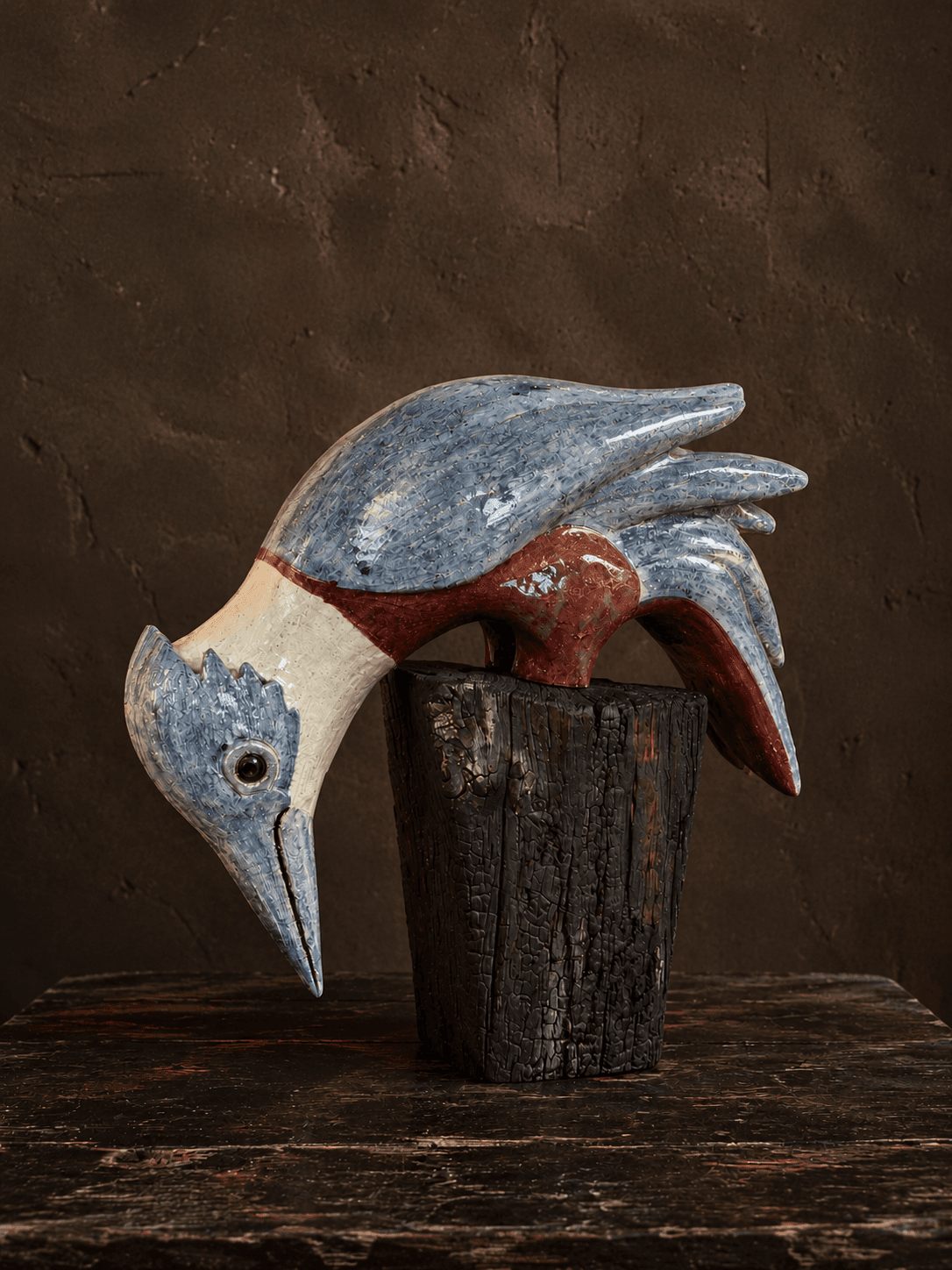
Minotaura, Minotaur Mask, Serpiente, Huevo, Three-Headed Flamingo, and Ciervo dios form a constellation of hybrid beings. *Minotaura* fuses the human and the animal, introducing a gender shift into this myth, which the artist has reimagined for the present day. Minotaur Mask presents an enigma regarding identity—who would we be if our eyes were positioned behind it?—while *Serpent’s Egg* evokes latent life, *Serpent* suggests the cycles of renewal, life, and death, and Three-Headed Flamingo multiplies our perspectives; meanwhile, a human face, caught in a silent scream, extends its existence into the bark of a tree.
Among these creatures, the Deer God occupies a central position, its antlers linked to fertility, renewal, and the vital power of the forest. Together with the Owl with Bull Horns, it appears to reign over and guard a territory where various forces and spirits of nature coexist. Here, De Ridder constructs a mythology of her own—one in which ancestral symbols resonate alongside an imagination that explores the infinite possibilities for the transformation of life. Could these be memories of a possible future?
In Staying with the Trouble, theorist and philosopher Donna J. Haraway proposes that we think about existence through the bonds of interdependence that constitute us, and through the possibility of establishing kinship beyond the human realm. Her notion of “becoming-with” invites us to consider that life is constructed in relation to other beings—within a shared world where no existence can be understood in complete isolation. From this perspective, De Ridder’s creatures allow us to imagine alternative forms of coexistence. Their hybrid bodies blur the categories that separate humans from animals and plants.
A face transforming into a tree makes this continuity visible; the “Deer God” evokes an ancestral bond with the forest, while “Minotaura” brings together human and animal attributes within a single body. These figures open up a speculative space where species can be understood through their relationships and transformations—transcending the hierarchies that typically organize and limit our perception.
The choice of ceramics as a medium deepens this connection to nature. Clay—shaped and transformed by fire—retains the imprint of the elements; the processes that give it form require air, water, earth, and fire. Traditional wood-firing techniques draw upon knowledge passed down through generations, demanding an attentive understanding of the material, the passage of time, and the unpredictable nature of fire.
Beyond the creative act itself, this relationship with nature is also shaped by a concern for deforestation and the destruction of habitats. The wood used to fuel the fire points toward threatened forests and the fragility of our ecosystems. How can we work with natural materials and inhabit the land without losing sight of the conditions that sustain life?
Thus, weaving together myth and matter, Desirée de Ridder constructs a universe that invites us to reconsider our relationship with all living things. Her sculptures reclaim the power of ancestral imaginaries and open up the possibility of conceiving other forms of kinship and coexistence among species. Modeled in clay and transformed by fire, these creatures seem to emerge from a deep memory to engage with the present. They remind us that inhabiting the world entails recognizing the bonds that connect us to other beings and assuming the responsibility to preserve the conditions that make such existence possible.
Cecilia Molina
Buenos Aires, octubre 202
+ View more
More Information
Desirée De Ridder (Buenos Aires, Argentina, 1971) studied painting at the Prilidiano Pueyrredón National School of Fine Arts (UNA, Buenos Aires) and animation at Central Saint Martins College of Art and Design in London. She received training in ceramics from Graciela Olio and Alejandra Jones.
In 2016, she was awarded the Third Prize in the Ceramics category at Argentina’s 105th National Salon of Visual Arts, and the following year, she served as a juror for the same event. She participated as an Argentine artist in *Something Else – Off Biennale Cairo* (2023) and has been a finalist in several prestigious competitions, including the Fundación Andreani Visual Arts Prize (2015) and the National Salon of Visual Arts (in the Ceramics category in 2016, 2014, and 2009), among others.
Her recent exhibitions include The Origin of the Origin at the Museum of Contemporary Art of Salta (2023); ArteBa (Oda Gallery, main section, 2022); Sacred Nature (Oda Gallery, Buenos Aires, 2022); and An Offering of Fire (The Collective 62, Miami, 2021). In 2023, she presented a large-scale installation at the Citadel as part of the Off Biennale Cairo.
She currently lives in the countryside, where she organizes artist residencies, leads workshops, and explores the connections between art and sustainability.